

By Dana Mykytyn
True Compliance Starts at the Device Level
True Compliance Starts at the Device Level
Why Recalled Equipment Can’t Be Documented Without It
Fire and life safety codes don’t just require inspections to occur, they require recalled equipment to be identified, documented, and communicated to building owners in writing. Meeting that standard depends on one critical capability: knowing exactly which devices are installed.
That level of certainty can only come from device-level data.
For more than 25 years, BuildingReports has been built around capturing inspection data at the individual device level. That long-standing foundation enables recall identification and documentation in a way that aligns directly with how NFPA and IFC codes are written, and how compliance is evaluated in the real world.
What the Codes Actually Require
Across NFPA and IFC standards, recalled equipment is consistently treated as a documented deficiency:
- NFPA 72 (14.2.2.3.3) requires that recalled equipment be reported to the building owner in writing and corrected.
- NFPA 25 (4.1.6.1.1 and 4.1.6.1.2) places responsibility on the owner for correction once recalled equipment is observed and documented.
- IFC 901.10 requires replacement of recalled equipment and notification to the fire code official once replacement occurs.
What these codes do not allow is ambiguity.
To “observe” recalled equipment, an inspector must be able to identify it. To notify an owner in writing, that identification must be documented. To support correction and replacement, the record must stand up to review.
That process assumes something very specific: the inspection system knows which devices are in the building at the device level.
Why System-Level or Form-Based Data Falls Short
Many inspection approaches focus on system-level summaries or form-based reporting. While those methods may confirm that an inspection occurred, they lack the detail required to consistently support recall compliance.
Without device-level data:
- Make and model information may not be captured
- Recalled devices may be indistinguishable from non-recalled ones
- Written owner notifications lack supporting evidence
- Deficiencies become harder to validate, defend, or track over time
- In contrast, device-level data creates a verifiable record of what was inspected, where it was located, and exactly what was found, which is what recall-related codes ultimately demand.
Device-Level Data, Defined
Device-level data means each individual device is:
- Uniquely identified (often via barcode)
- Physically verified during inspection
- Documented with make, model, and manufacturer
- Tracked over time with historical inspection results
- Associated with pass/fail outcomes and deficiencies
- This approach provides proof of presence and accountability while enabling recall identification that is specific, accurate, and defensible.
It also creates the foundation for long-term insights, such as failure rates, aging equipment trends, and proactive planning, that simply aren’t possible without device-level records.
Recall Support Built on a Proven Foundation
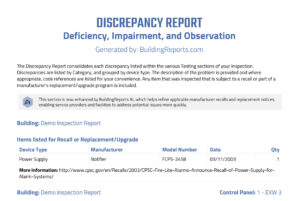
BuildingReports’ Manufacturer Recall Database is effective because it is built on this device-level framework. When inspection data already includes verified make and model information, recall identification becomes a natural extension of the inspection process, not an afterthought.
For members, this means:
- Clear identification of recalled equipment when present
- Documentation that supports written owner notification
- Deficiency reporting that aligns with NFPA and IFC expectations
- Records that stand up to scrutiny from AHJs, regulators, and legal review
- This isn’t a bolt-on feature or a recent adaptation. It reflects a reporting model that has been in place for more than two decades. One designed to meet the realities of compliance, not just the appearance of it.
Strengthening What Already Works with AI
As the industry evolves, so do the tools that support it. BuildingReports has now leveraged AI to enhance this long-standing recall support and build on the same device-level data and reporting standards members rely on today.
These AI-backed enhancements are focused on delivering greater clarity, efficiency, and insight, while preserving the accuracy and accountability that compliance requires. The workflow remains familiar; the foundation remains unchanged. What’s different is the added intelligence supporting it.
Compliance That Holds Up in the Real World
In environments where inspections, recalls, and deficiencies carry legal and safety implications, documentation quality matters. BuildingReports supports high-standard reporting that integrates:
- NFPA code references
- Documentation-level inspection records
- Proof of presence and verification
- Historical device data
- Reporting that stands up to scrutiny
- When recalled equipment is identified, there’s no question of how it was found or why it was documented. The data speaks for itself.
The Bottom Line
Codes don’t ask whether an inspection was completed. They require proof that recalled equipment was identified, documented, and addressed.
That proof begins at the device level.
For more than 25 years, BuildingReports has been built around that reality: supporting recall compliance through detailed, verifiable data. With AI-enhanced capabilities now strengthening this proven approach, members can continue to meet code requirements with confidence, clarity, and consistency.
Because when compliance is evaluated, details aren’t optional. They are expected.
Category: Building Inspections | Building Management | Codes & Standards
Tags: Codes & Standards | Compliance | Facility Management
SHARE